Duct & Vent Repair
Most "my AC is weak" calls are not an equipment problem. The equipment makes conditioned air; the duct system is what fails to deliver it. A house can lose a quarter of what it pays to heat and cool into an attic through joints that were never sealed properly.
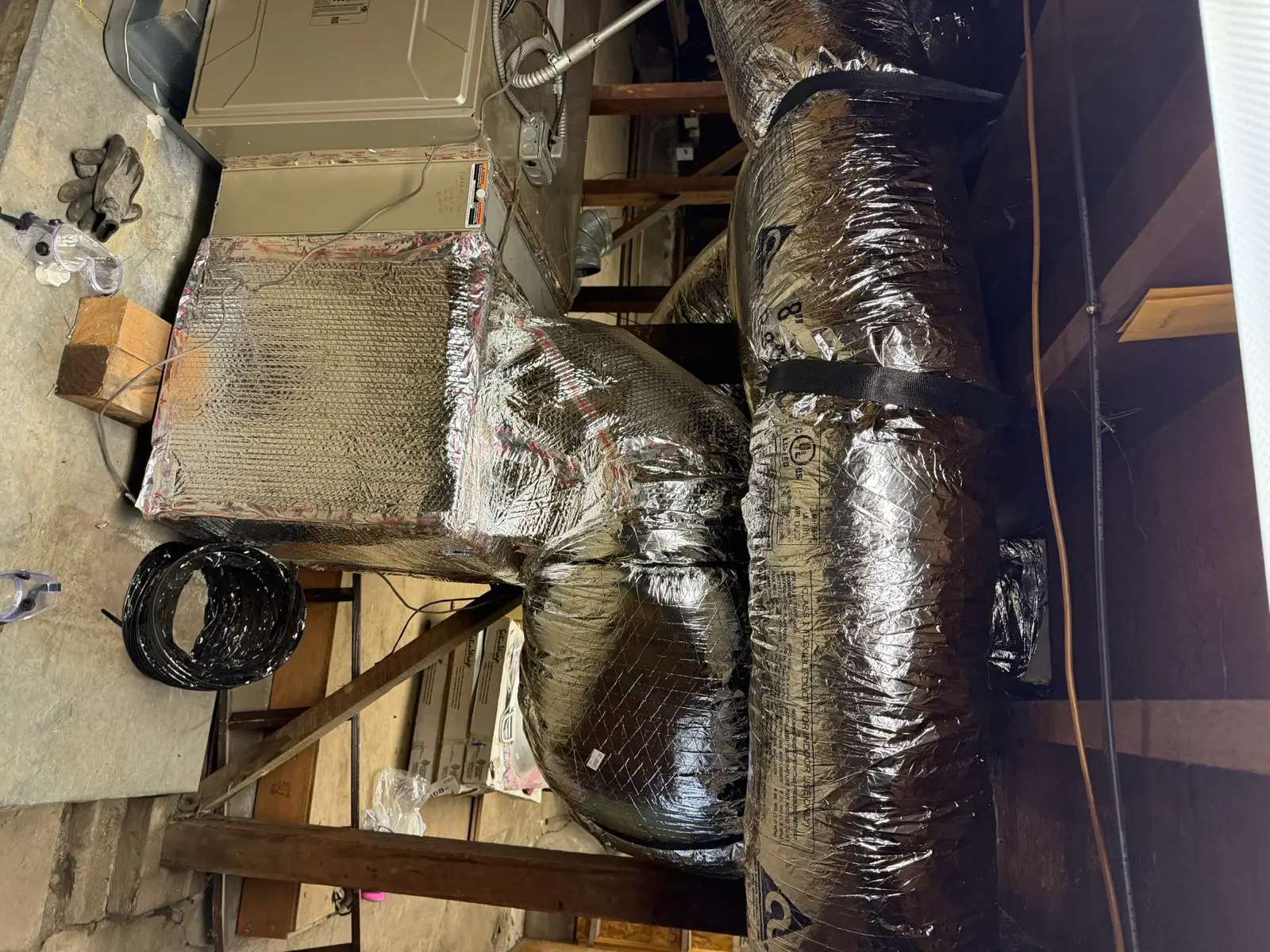
What points at the ducts
- One room never gets comfortable while the rest of the house is fine
- Weak air from the registers even with a clean filter
- Energy bills climbing with no change in how you use the system
- Dust settling again days after you clean
- Rooms farthest from the furnace are always the worst
- Whistling, booming, or rattling in the ducts when the blower starts
- Attic or crawlspace smell coming through the vents
- Visible disconnected, crushed, or sagging flex duct
Leaks first, everything else second
Duct leakage is the biggest and least visible waste in a typical house. Return-side leaks are the worse half: a return leaking in an attic pulls 130-degree attic air — plus whatever insulation dust is up there — straight into the air you breathe, and the system pays to condition it.
We seal with mastic and mesh at the joints and boots, not tape. Standard cloth duct tape fails on ducts; the adhesive dries and lets go in attic heat, which is why it is one of the few products that does not do the job its name describes. Foil tape rated for the application holds, but mastic is what we use where the joint has to last.
Static pressure tells you which problem you have
Before we quote duct work we read static pressure across the system. Most residential equipment is rated for about 0.5 inches of water column total; a great many houses measure well past that, and the blower has been fighting the duct system for years.
High static pressure narrows the cause quickly — an undersized return, a crushed or kinked flex run, a closed-off branch, or a filter far more restrictive than the system was designed for. Which of those it is decides whether you need a repair, a new return, or a redesigned trunk. Replacing equipment without fixing it just puts a new blower behind the same restriction.
Repair, seal, or replace
Sealing and repair handle most of it — reconnecting boots, replacing crushed sections, supporting sagging runs so they stop pooling, and sealing the joints and plenum. Replacement is the honest answer when the system is old panned-joist or deteriorated flex whose inner liner has torn away from the collar, because there is nothing sound left to seal to.
Insulation matters in the same breath. Duct running through an unconditioned attic needs real insulation value around it — current California prescriptive requirements land at R-8 for most residential runs — and older houses frequently have R-4 flex that was code decades ago and is not now.
Duct work triggered by a change-out
When you replace a furnace or air conditioner in California, the duct system is part of the permitted job. Title 24 requires duct leakage to be tested and verified by an independent HERS rater on most equipment change-outs, and the alteration standard is a single-digit to low-teens percentage of system airflow depending on which compliance path the job takes.
This is the part unpermitted installs skip, and it is why a change-out that came in unusually cheap tends to show up later as a failed test at resale. Licensed and Bonded under CSLB #1107541 — we pull the permit and the testing is part of the quote.
Dryer vents
We install, reroute, and replace dryer vents, which is the same trade and a real safety item. Lint accumulation in a long or crushed run restricts airflow, makes the dryer run hot through two or three cycles to finish a load, and is a documented ignition source in home fires.
The usual culprits are a flexible foil or plastic duct where rigid metal belongs, a run that is simply too long for the appliance, and crushed pipe behind the machine. Rigid metal, the shortest practical path, and a proper termination fixes it.
Want it looked at?
Flat $85 diagnostic across Contra Costa, Alameda, Solano & Napa Counties. Mon–Sat, 8:00 AM – 5:00 PM.
Mon–Sat, 8:00 AM – 5:00 PM · Flat $85 diagnostic · CSLB #1107541
Common Questions
Is duct cleaning worth it?
Duct cleaning on its own is not something we roll a truck for, and for most homes it is not the thing worth buying either: the EPA’s long-standing position is that routine duct cleaning has not been shown to prevent health problems, and it does nothing about leakage — which is the actual driver of high bills, dust and uneven rooms. What we do is the work behind those symptoms: sealing leaks, repairing damaged runs, and replacing duct that is past saving. If the problem is visible mold growth, a rodent or insect infestation, or heavy construction and smoke debris, that is remediation work and wants a specialist with containment equipment. Call and describe what you are seeing — we will tell you which of the two it is.
Why is one room always hotter or colder than the rest?
Usually airflow, not capacity. The common causes are a branch duct that is crushed, disconnected, or undersized for the distance it travels, a return that cannot pull enough air back, or a system so oversized that it satisfies the thermostat before conditioned air ever reaches the far end of the house. A static pressure reading plus airflow at that register separates those in one visit.
How much can leaking ducts cost me?
Federal energy guidance has long put typical duct losses in the neighborhood of 20 to 30 percent of the air moving through the system in houses with ducts in unconditioned space, which is the common arrangement here. That is a fifth to a third of every heating and cooling dollar, and it compounds because the equipment runs longer to compensate.
Do you have to tear open ceilings to fix ducts?
Rarely in the houses we work on. Most Contra Costa duct runs are accessible from the attic or the crawlspace, which is where the work gets done. Ducts buried in a finished ceiling or a slab are the exception, and if that is what you have we will tell you what access actually requires before anything gets opened up.
What does a duct diagnostic cost?
The same flat $85 as any other visit — static pressure, airflow, and an inspection of the accessible duct runs, with the repair priced before any work starts. Duct leakage testing by a HERS rater is separate and is normally part of a permitted equipment change-out rather than a standalone repair.
Request Service
Tell us what's going on and we'll get back to you. Diagnostic visits are a flat $85. Prefer to talk? Call (925) 433-6400.